
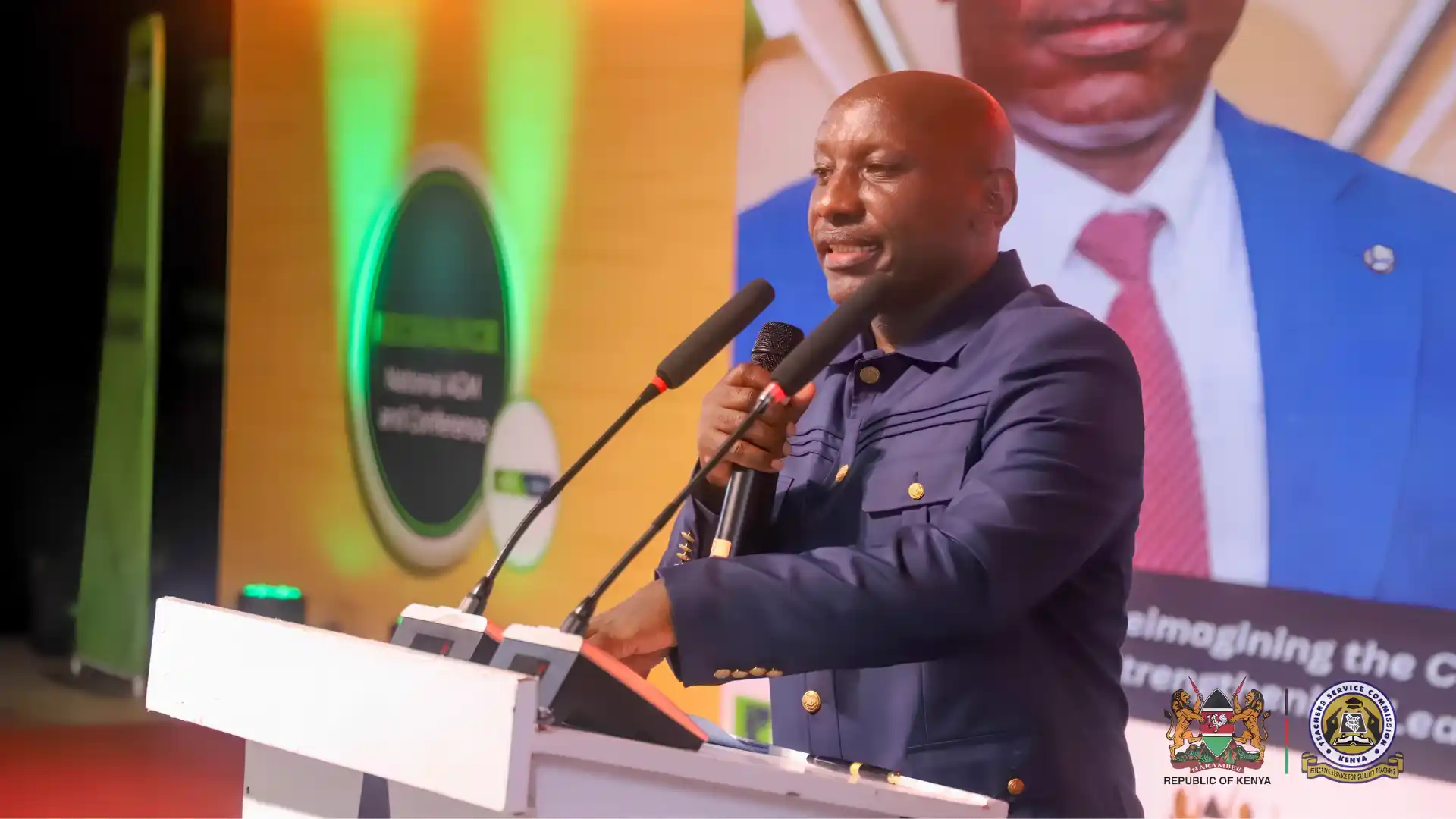
Teachers Service Commission (TSC) Chairperson Dr Jamleck Muturi has told school heads that the greatest damage to the teaching profession’s reputation comes from inside it, and that nothing justifies the abuse of a child by anyone entrusted with their care.
He spoke at the 2026 Kenya Comprehensive School Heads Association (KECSHA) annual general meeting and conference in Mombasa, which opened on 9 November 2026. More than 15,000 head teachers attended his address at the Sheikh Zayed hall.
What Dr Muturi said about professional conduct
Dr Muturi spoke plainly about trust. ‘The greatest damage to the reputation of our profession does not come from outside,’ he said. ‘It comes from the few among us who betray trust.’
He said every misused resource, every abused learner and every falsified record harms the dignity of thousands of faithful colleagues. On child protection, he said: ‘There is no excuse, no justification, and no explanation for abuse of a child by anyone entrusted with their care.’
The chairperson said TSC will handle all disciplinary cases fairly and strictly in line with due process. He described accountability and professional ethics as non-negotiable.
Prevention begins with school leadership
Dr Muturi said prevention through strong leadership at school level remains the first line of defence. He asked principals to:
- build safe school environments where child protection is uncompromising
- handle minor disciplinary matters fairly and early
- manage school resources with care and transparency
- work closely with Boards of Management, parents and local communities
He said school leadership is the biggest influence on learning outcomes after classroom teaching itself.
Recognition for teachers’ daily work
The chairperson also acknowledged teachers’ concerns about workload, infrastructure, the pace of curriculum change and promotion. He singled out the long-serving teacher who feels forgotten.
‘In classrooms, under trees, in overcrowded classrooms, in schools far from tarmac, Kenyan teachers show up,’ he said.
Comprehensive schools and the CBE transition
Dr Muturi said the Competency-Based Education (CBE) curriculum is no longer an experiment but the national curriculum, with learners now moving through Junior School and into Senior School.
He told the delegates that comprehensive schools sit at the centre of that change because they host several learner levels under one gate, with learners of different ages, teachers from different training backgrounds and varied parental expectations. ‘You are running laboratories of the future of Kenyan education,’ he said.
Three TSC milestones outlined
The chairperson named three areas where TSC is responding to teachers’ feedback on workload, career progression and professional development:
| Milestone | What Dr Muturi said |
|---|---|
| Career Progression Guidelines | The revised guidelines, signed in June 2026, let classroom teachers rise through the ranks to the equivalent of a chief principal without moving into administration. |
| Teacher Professional Development (TPD) | A refined and accessible continuous learning model covering digital literacy, inclusive education and modern pedagogy, designed not to act as a barrier. |
| Teacher Mobility Policy | A framework to ensure Kenyan teachers seeking opportunities abroad do so within a structured, safe and professional system that protects their credentials. |
TSC and the three teachers’ unions, KNUT, KUPPET and KUSNET, signed the revised Career Progression Guidelines on 18 June 2026. TSC has said the guidelines cut the time needed to reach the highest professional grade from about 30 years to about 18.
The closing message
Dr Muturi said a nation cannot rise higher than the quality of its teachers, and a teacher cannot rise higher than the leadership, support and professional standards around them. He urged school heads to strengthen leadership, professionalism and quality education.