
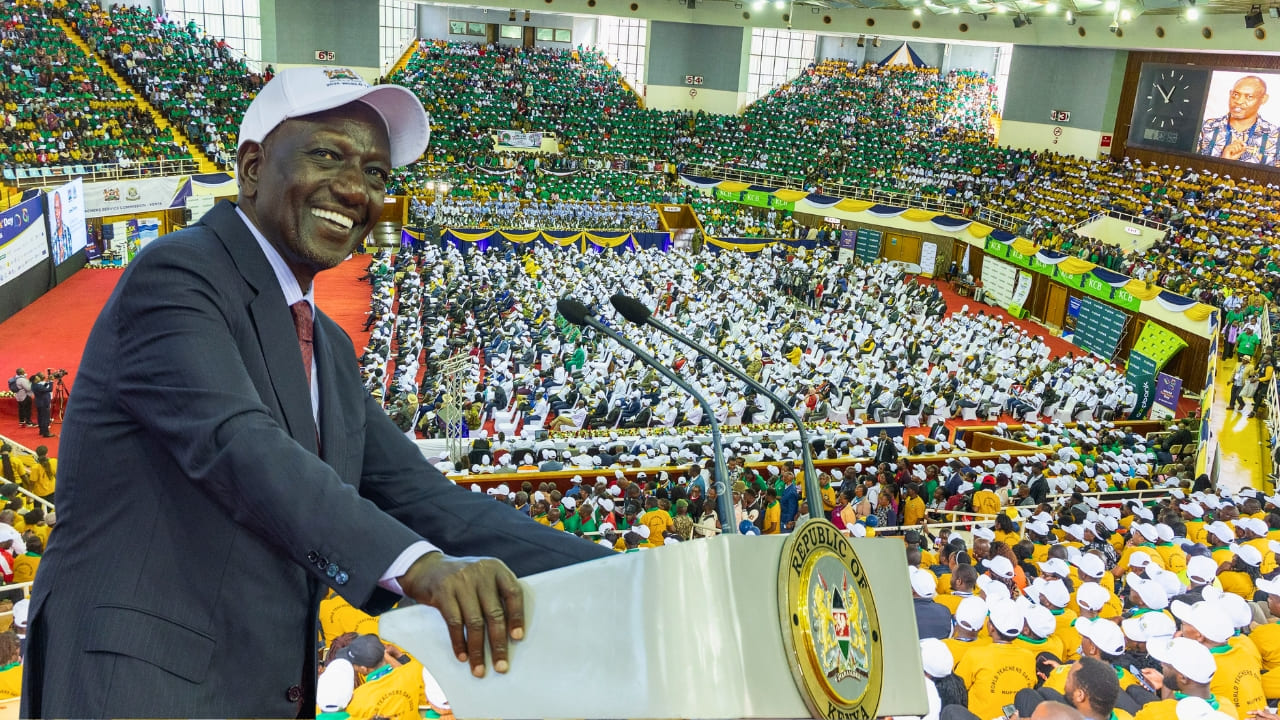
President William Ruto thought a new housing perk would win over Kenya’s exhausted teaching force; instead, he got an ultimatum.
Speaking at Kasarani Stadium during World Teachers’ Day, Ruto unveiled an automatic payroll deduction scheme to help educators purchase state-built homes. Inside the packed arena, the silence was total. Days later, KUPPET Secretary-General Akelo Misori delivered the union's response: a nationwide boycott of the 2026 national examination exercises, slamming the state’s “slavery wages” for invigilation and marking.
The standoff lays bare a fatal flaw in East Africa’s boldest educational experiment. As Kenya prepares to push its pioneer Competency-Based Curriculum (CBC) cohort into Grade 10 Senior School, politicians continue to treat teachers as campaign photo-ops rather than essential partners.
If Kenya’s multi-billion-shilling curriculum overhaul fails, it will not be due to flawed pedagogical theory. It will fail because the government refuses to treat educators with basic policy respect.
A Curriculum Built on Quicksand
Moving away from the high-stakes, rote-memorization pressure of the 8-4-4 system toward practical skills and tailored learning pathways—STEM, Social Sciences, and Arts—is precisely what East Africa’s largest economy needs.
Yet pedagogical vision without execution is merely rhetoric.
In public secondary schools, the numbers do not add up. The Teachers Service Commission (TSC) estimates national staffing deficits at over 100,000 educators. Under CBC guidelines, a Senior School must offer specialized tracks requiring dedicated laboratories and subject-matter experts. In rural counties like Kilifi or Turkana, existing Junior Secondary Schools rely on three or four intern teachers to deliver up to twelve subjects to hundreds of students.
"We are asked to teach STEM courses without working science labs and creative arts without materials," says Wycliffe Otieno, a physics teacher in Nakuru. "When politicians visit Nairobi, they talk about digital literacy. When we walk into the classroom, we lack textbooks for every three learners."
Turf Wars and Union Distractions
Rather than addressing these shortfalls, the state and union leadership remain entangled in bureaucratic squabbles.
A turf war between KUPPET and the Kenya National Union of Teachers (KNUT) over representing Junior Secondary School educators has paralyzed constructive bargaining. Instead of demanding better working conditions, union leaders spend critical months fighting over member dues and territory.
Concurrently, the Ministry of Education and TSC rely on temporary stopgaps:
- Deploying underpaid intern teachers on short-term contracts.
- Issuing circulars that reshuffle existing staff without increasing total headcount.
- Threatening disciplinary action whenever union leaders raise wage concerns.
This management by decree fractures trust. Treating national examinations as a security operation requiring paramilitary oversight—while paying invigilators sub-standard daily allowances—sends a clear signal: the government trusts teachers to enforce mandates, but not to shape policy.
The High Cost of Misaligned Priorities
Physical infrastructure—housing units, modern classrooms, and administrative blocks—yields ribbon-cutting ceremonies. Investing in human capital through competitive salaries and continuous professional development requires sustained commitment without immediate political payoff.
Yet no education system outpaces the quality of its teachers.
Countries that successfully transitioned to competency-based frameworks, such as Finland and Singapore, elevated teaching into a high-status profession. Kenya is attempting the opposite: executing a complex curriculum transformation while keeping its teaching force financially stressed and politically marginalized.
The consequences are already showing up in School-Based Assessments, where Junior Secondary learners reveal concerning gaps in core competencies. Parents, burdened by rising living costs and direct levies, are increasingly vocal about the lack of dedicated instruction in specialized subjects.
Restoring Equity Before Senior School Implementation
With the Cabinet adopting a new Sessional Paper on Transforming Education, the government has another theoretical roadmap to address shortages. But policy documents will not fill empty classrooms.
To salvage the Senior School rollout, the Ministry of Education and TSC must shift from political grandstanding to operational support:
- Regularize Intern Contracts: Transition all contracted JSS intern teachers into permanent, pensionable appointments.
- Resolve Exam Compensation: Establish a transparent wage baseline for examination invigilation and marking to end annual strike threats.
- Fund Track Specialization: Allocate direct capital grants to secondary schools for STEM labs and arts resources prior to subject selection.
- Depoliticize Welfare Programs: Keep mandatory payroll deductions separate from union agreements and focus benefits on wage relief.
Kenya’s learners cannot afford another cycle of disruption. The Competency-Based Curriculum holds real promise for transforming human capital, but that promise remains unfulfilled until state leadership stops using teachers as political chess pieces and starts treating them as partners in reform.