
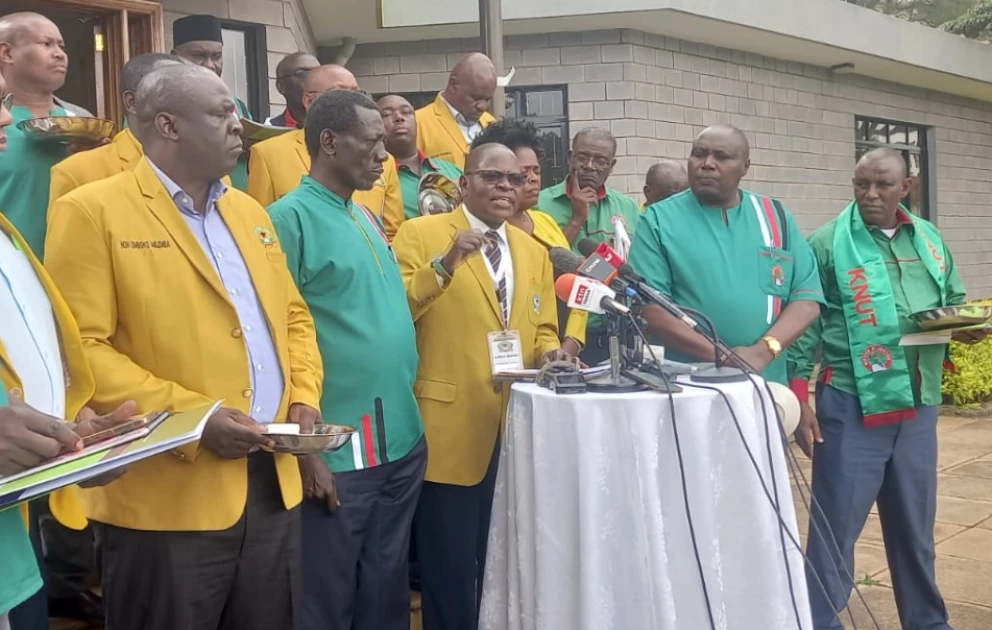
The Dark Side of Teachers' Unions in Kenya: Corruption, Strikes, and Betrayal
Kenyan teachers are represented mainly by two trade unions: the Kenya National Union of Teachers (KNUT), formed in 1957, and the Kenya Union of Post-Primary Education Teachers (KUPPET), registered in 1998. Both were set up to defend teachers' pay, terms of service and working conditions, and both have won gains through collective bargaining with the Teachers Service Commission (TSC).
In recent years, many teachers have questioned how union money is handled, whether leaders act independently, and whether rivalry between unions leaves members worse off. A separate controversy now surrounds the Kenya Women Teachers Association (KEWOTA), a welfare association whose payroll deductions from female teachers are before the courts and Parliament.
This article looks at these concerns. Where something is an allegation rather than an established finding, the article says so.
Concerns Over Union Finances and Accountability
Teachers' union dues are deducted directly from their salaries through the TSC payroll, so members have a direct interest in how the money is used. Most complaints in recent years have concerned welfare funds, especially the Burial and Benevolent Fund (BBF), which members contribute to monthly.
In 2024, KUPPET's national treasurer accused officials of the Laikipia branch of mismanaging the branch BBF and wrote to the county labour office asking for the branch officials' bank accounts to be suspended. The branch leadership rejected the claim. They said the branch had been audited by the Registrar of Trade Unions and given a clean bill of health.
In 2025, the Commission on Administrative Justice ordered KUPPET to release records of the Kisii branch BBF, including bank statements and payment vouchers, after a paid-up member said he had been denied access to them. In 2026, junior secondary teachers in Laikipia publicly asked for the branch to disclose its monthly BBF contributions.
These cases show members pressing for transparency. They are disputes and complaints, not findings that unions as a whole have misused funds. Still, they explain why trust in union accounting has become a recurring issue.
The KEWOTA Deductions Controversy
What KEWOTA Is
KEWOTA describes itself as a welfare association for women in the teaching profession, offering table banking, mentorship, welfare support and professional development. It says it was first registered in 2007. It is not one of the two unions that negotiate the teachers' Collective Bargaining Agreement (CBA) with TSC, but it receives member contributions through the TSC payroll check-off system.
The Allegations
Questions about KEWOTA's deductions are not new. In June 2019, the then KNUT Secretary-General Wilson Sossion wrote to the Ethics and Anti-Corruption Commission (EACC) and the Directorate of Criminal Investigations (DCI). He alleged that Sh200 had been deducted from about 58,000 female teachers who had not authorised it, and he asked for TSC officials to be investigated.
KEWOTA's co-founder said at the time that the association champions women's rights and does not compete with the main teachers' unions. In 2023, five KUPPET officials went to court, on behalf of affected teachers, against TSC, KNUT, EACC and their own union. They sought to stop the deductions and obtain refunds. TSC's position then was that teachers could stop unauthorised deductions through the T-Pay system.
The issue returned in April 2026 after a KTN investigation aired on 12 April and reports in The Standard the next day. They alleged that Sh200 was being deducted monthly from tens of thousands of female teachers, many of whom said they had never agreed to it. They also alleged that KEWOTA officials had employed relatives and associates on high salaries. Reports differ on how many teachers are affected, ranging from about 58,000 in the 2019 complaint to 95,000 and more than 100,000 in 2026 coverage.
KEWOTA has denied wrongdoing. Its chairperson called the claims baseless and a fabrication, and the association has said its books of accounts are up to date.
TSC's Suspension and the Court Order
In a letter dated 15 April 2026, TSC suspended KEWOTA-linked deductions from the April payroll pending an independent inquiry. It said it had noted the media reports with concern. It cited the Teachers Service Act and its third-party deduction guidelines.
Two days later, the Employment and Labour Relations Court temporarily suspended TSC's decision. KEWOTA had argued that TSC acted on unverified media reports without hearing it. The effect was that deductions could continue until the court gave further directions. Separately, a group of female teachers filed a petition in Kakamega seeking refunds of deductions dating back to 2019, and another teacher challenged the deductions as unlawful for lack of consent.
Reports also said that KEWOTA's Nairobi offices were broken into around the time of TSC's decision, with computers and servers taken. The reports did not establish who was responsible or whether the incident was linked to the controversy.
Parliament and the Unanswered Questions
A National Assembly departmental committee summoned KEWOTA's leadership in late April 2026. The association asked for two weeks to prepare its documents, including its financial audit report, and the committee agreed.
The latest reports show the matter still pending. The findings of TSC's independent inquiry had not been made public, and the court had not issued a final ruling. The central questions remain whether each deduction was authorised, whether TSC followed proper procedure in processing and then suspending it, and how contributions collected through payroll are accounted for.
What Teachers Can Do
Teachers who see an unfamiliar deduction can check their payslip on T-Pay and raise it with TSC. Members of any union or association can also request its records in writing. The Kisii BBF case shows that such requests can succeed when pursued through the proper channels.
Poaching of Members and Turf Wars
Union rivalry has been most intense over junior secondary school (JSS) teachers. KNUT argues that JSS sits within comprehensive schools alongside primary classes, so its teachers belong in KNUT. KUPPET argues that JSS is a secondary section and that its teachers belong in KUPPET. Early in 2025, a major newspaper reported that about 46,000 JSS teachers were set to join KUPPET.
The dispute has intensified. In September 2026, KNUT branch officials in several counties accused TSC of moving teachers from KNUT to KUPPET after JSS deployment without their consent. They claimed between 10,000 and 15,000 teachers had been moved nationally. These figures are KNUT's claims and have not been independently confirmed. KNUT has also questioned why welfare deductions start automatically for KUPPET members while KNUT members must separately enrol in its Burial and Benevolent Scheme.
The Employment and Labour Relations Court has directed TSC to deduct and remit September 2026 agency fees from JSS teachers to KUPPET, in line with a consent order between the two unions. The case was due to be heard on 5 October 2026. KUPPET has previously said that non-members who benefit from its CBA are liable for agency fees. The two unions also disagree on policy: KUPPET wants JSS to run as autonomous schools with their own management, while KNUT wants junior secondary sections to remain part of comprehensive schools.
Strikes and Last-Minute Reversals
The clearest example of the unions failing to act together came in August 2024. KNUT and KUPPET had both issued strike notices over the implementation of the second phase of the 2021–2025 CBA, promotions, permanent terms for intern teachers and other demands. On 25 August, KNUT's National Executive Council withdrew its notice, citing commitments from TSC, including the promotion of 51,232 teachers. KUPPET went ahead the next day, and its Secretary-General said the strike covered all teachers in the public service. The strike lasted more than a week and ended after a tentative agreement with TSC.
Strikes have been part of teacher unionism in Kenya for decades. They can win concessions, but they also cost learners time in school. Critics argue that the unions too often rely on strike threats instead of earlier, quieter negotiation. The unions respond that strike notices are a legal tool and that they act when TSC delays commitments it has already made.
Mistrust Over CBA Negotiations
The same distrust surfaced before the 2025–2029 CBA talks. At a school heads' conference in Mombasa in June 2025, KUPPET's Secretary-General warned KNUT not to betray it as, he said, it had in the previous round. He said KUPPET had lost that earlier agreement because KNUT left it exposed during talks. The 2021–2025 CBA that resulted was non-monetary. KNUT rejected the suggestion of betrayal and pointed to the two unions' joint rejection of the 2019 cashless CBA.
Mistrust has continued since the agreement was reached. In July 2026, KUPPET called for the 2025–2029 CBA to be reviewed, arguing that its pay increases fall short of teachers' needs. These are the unions' positions, and the disagreement shows how fragile their cooperation can be.
When Court Battles Cost Members: The 2019 Pay and Promotion Dispute
KNUT's litigation against TSC has sometimes carried a cost for its own members. In July 2019, the Employment and Labour Relations Court quashed TSC's Career Progression Guidelines (CPGs) for KNUT members and said terms should follow the schemes of service.
TSC then said it could not implement the 2017–2021 CBA's third phase for KNUT members under the ruling. As a result, 103,624 KNUT teachers missed the pay rise, while KUPPET members and teachers in no union received it. Reports at the time also described an exodus of teachers from KNUT to KUPPET.
KNUT, led then by Sossion, defended the court victory and accused TSC of punishing teachers for union membership. TSC said it was complying with the court's ruling. The episode remains a reference point in debates about whether confrontational legal strategies serve members well.
Political Interference and Independence
Critics have long argued that union leaders' political connections can blur their role as independent advocates for teachers, and that alliances with those in power can weaken bargaining. Union officials reject this and say their decisions are made by elected councils.
Recent controversies show how political influence over teachers' careers is also a live concern. In July 2026, KNUT raised concerns about alleged political interference in teacher transfers in Lurambi, Kakamega County, and asked TSC to protect teachers from it.
In August 2026, Speaker Moses Wetang'ula alleged that some MPs receive TSC employment letters for constituents and that some are sold, citing one case in which a parent was allegedly asked for Sh400,000. The chair of the National Assembly's education committee denied that this happens and said the committee would ask for the Speaker's evidence. These allegations concern politicians and recruitment processes, not the unions, but they show why teachers expect their unions to defend the integrity of TSC's processes.
Leadership Rules and the Retirement Age
Disputes over leadership terms have reached the courts. KUPPET's 2024 amended constitution raised the retirement age for serving union officials from 60 to 65. The amendments faced petitions at the Employment and Labour Relations Court from members and officials who challenged them, and some members regarded the changes as favouring the officials themselves.
In December 2025, the court upheld the amendments, so officials can remain in office until 65 within the union's five-year term. The union has said it will continue to hold elections under the amended constitution, and the Ministry of Labour has questioned how the polls were convened while the matter was contested.
Teachers' Welfare, Health Cover and Interns
Teachers' welfare is a major reason people join unions, and it is also where members measure them. In April 2026, complaints about outpatient limits and delays under the Social Health Authority (SHA) cover led KNUT and KUPPET to threaten to pull out of the arrangement if the cover is not improved.
The unions have also pushed for permanent terms for intern teachers, and TSC has about 44,000 interns. In the 2026/27 budget, Parliament allocated Sh4.9 billion for converting 20,000 interns to permanent terms, compared with the Sh7.2 billion TSC had requested, leaving a Sh2.3 billion gap. How that gap is closed will test the unions' ability to deliver for their newest members.
The Struggle for Supremacy
The rivalry between the unions is not new. KUPPET's own account says the idea of a separate union for graduate teachers dates to 1985. Its first attempt to register in 1993 was blocked when a rival union obtained court orders, and it was finally registered on 26 November 1998. Since then, each union's membership gains have often been seen as the other's losses.
Critics argue that this competition lets TSC and the government deal with the unions separately, which can lead to weaker agreements and longer disputes. Supporters of competition say it gives teachers a choice and pushes the unions to perform. Either way, how the unions handle money, membership and negotiations will decide whether teachers trust them.