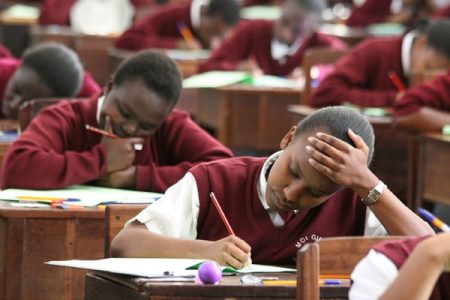
The core written papers of the 2026 KCSE began on Monday, 2 November, with English Paper 1 at 8:00 am and Chemistry Paper 1 at 2:00 pm. The week runs through Friday, 6 November, covering English, Mathematics, Chemistry and Kiswahili, plus the Chemistry practical.
Some candidates sat earlier papers. Oral and practical assessments began on 19 October, and written papers in foreign languages, Music and technical subjects started before 2 November. This guide covers the week that most of the roughly one million candidates are sitting now.
KCSE 2026 first-week timetable
| Date | Morning (8:00 am) | Afternoon (2:00 pm) |
|---|---|---|
| Mon 2 Nov | English Paper 1 (8:00-10:00 am) | Chemistry Paper 1 (2:00-4:00 pm) |
| Tue 3 Nov | Mathematics Paper 1, Alt A or B (8:00-10:30 am) | English Paper 2 (2:00-4:30 pm) |
| Wed 4 Nov | Chemistry Paper 2 (8:00-10:00 am); General Science Paper 1 (8:00-10:30 am) | English Paper 3 (2:00-4:30 pm) |
| Thu 5 Nov | Kiswahili Lugha | Kiswahili Insha |
| Fri 6 Nov | Chemistry practical | None listed |
Times are those reported from the KNEC timetable. Candidates sitting adapted papers, such as Braille or large print, may have different durations and should confirm with their centre.
What each paper covers
English Paper 1 tests functional skills, and Paper 2 covers comprehension, literary appreciation and grammar. Paper 3 is creative composition and essays based on set texts.
Mathematics Paper 1 is taken as Alternative A or B depending on the candidate’s registration. Paper 2 follows next week, on Monday 9 November.
Chemistry has two theory papers this week and a practical on Friday. Kiswahili Fasihi, the third Kiswahili paper, comes on 9 November.
Two details worth checking
The two-paper days. Monday has English in the morning and Chemistry in the afternoon, with a four-hour gap. Tuesday has Mathematics followed by English Paper 2. Candidates should eat, rest and avoid cramming new topics between sessions.
Kiswahili and the Chemistry practical. Their exact times were found in only one published timetable guide, and KNEC’s PDF could not be opened for checking. Teachers should confirm these against the printed KNEC timetable held at the centre before telling candidates.
What candidates may and may not carry
- Allowed: blue or black ink pens, with a pencil for diagrams only; geometrical instruments; and a non-programmable calculator in subjects where KNEC permits one.
- Not allowed: phones, wristwatches of any kind, smartwatches, notes, earphones and any other device that can store text or communicate.
KNEC reminded centres on 1 November that wall clocks must be placed in every exam room because candidates cannot wear watches. Entering an exam room with unauthorised items counts as malpractice and can lead to cancelled results.
Start times and reporting
First-session papers start at 8:00 am and second-session papers at 2:00 pm. Containers are opened at 7:00 am, and papers are issued only after the opening checks. Arrive early, because a latecomer must give the supervisor a satisfactory reason before being allowed in.
What happens after the first week
The second week begins on Monday 9 November with Mathematics Paper 2 and Kiswahili Fasihi, followed by religious education, Biology and History. Geography, Physics, Business Studies and Agriculture come in the final week, and the last paper is the Physics practical on Friday, 20 November.
Read Also: How to Check KCSE Results Online: KNEC Steps and Contacts
Frequently asked questions
Which paper started the KCSE theory exams on 2 November?
English Paper 1, in the morning, with Chemistry Paper 1 in the afternoon.
When is the Chemistry practical?
Reported as Friday, 6 November. Confirm with your centre’s printed timetable.
Can candidates wear analogue watches?
No. KNEC bars wristwatches of any kind, and centres must provide wall clocks.