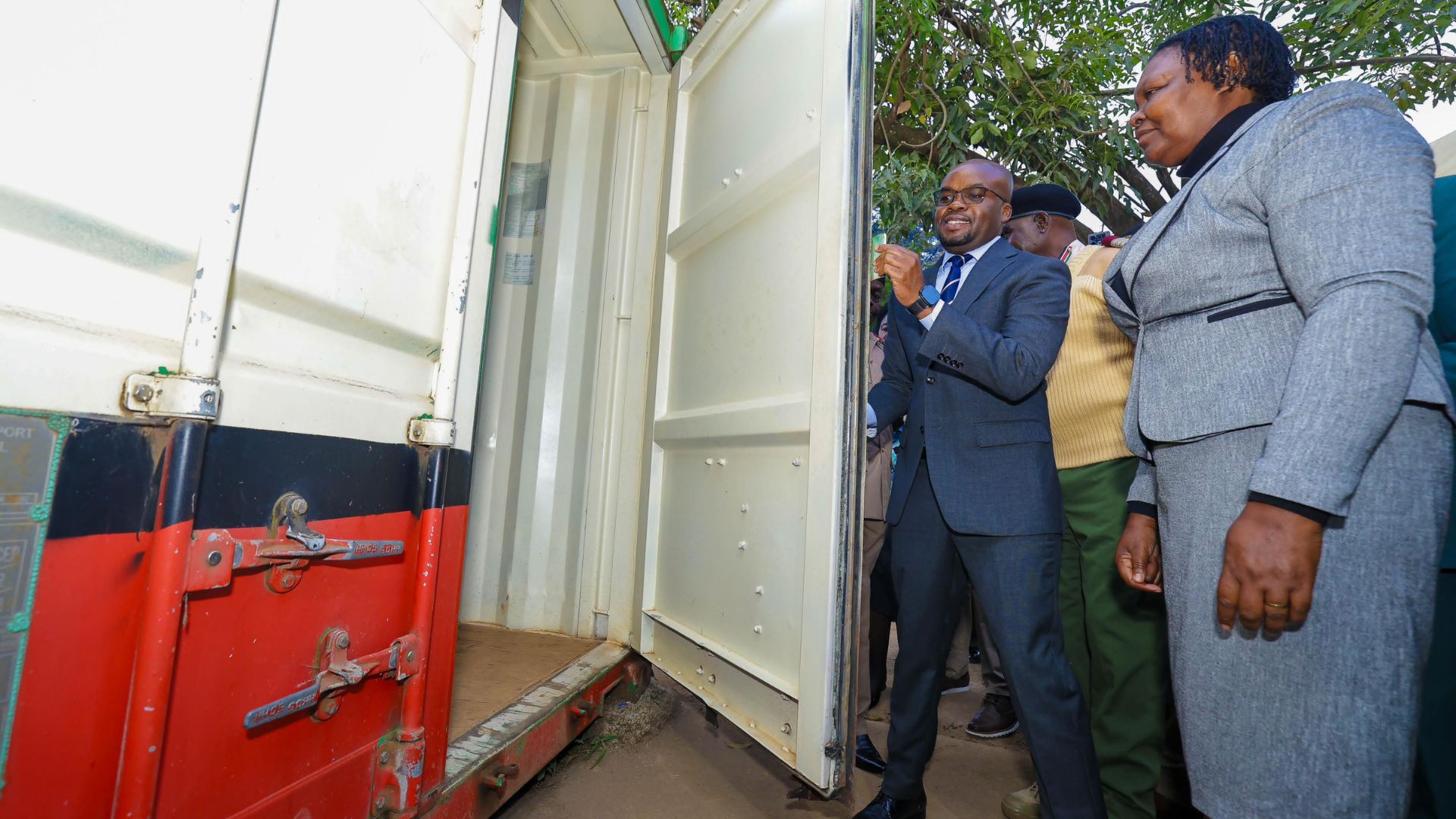
For the 2026 national exams, every KNEC examination storage container is secured with a smart padlock that reports to the council’s headquarters. The locks record when a container is opened or closed, so an unusual opening can be spotted as it happens. KNEC is also contracting 342,005 professionals to run the exams and assessments, which involve 3,634,846 candidates.
This is the first season the locks cover all containers. In 2025, they were tested on 250.
What the smart padlocks do
The padlocks are linked to the KNEC Command Centre. According to the Education Cabinet Secretary, that allows real-time tracking of the exact time each container is opened and locked. KNEC says the system also helps detect tampering.
The padlocks add to the physical security rather than replacing it. Containers have a double-locking system, and armed officers guard them. KNEC says each container has four armed security officers, two on day duty and two at night.
When containers can be opened
Container access is tightly timed.
| Assessment | Container access |
|---|---|
| KPSEA and KJSEA | From 6:00 am |
| KCSE | 7:00 am (morning session) and 12:30 pm (afternoon session) |
KCSE papers are also separated by session. Morning papers are packed in white cartons with blue straps, and afternoon papers in yellow cartons with black straps, to reduce the risk of mix-ups.
The scale of the 2026 operation
KNEC will administer the national exams and assessments between mid-October and 20 November 2026. The figures given by the CEO are:
- 3,634,846 candidates across KPSEA, KJSEA and KCSE, about 6 per cent more than in 2025
- 342,005 contracted professionals, including centre managers, supervisors, invigilators, security officers and drivers
- 701 storage containers nationwide, after 48 new containers were installed in sub-counties
For KCSE alone, KNEC reported 10,765 centre managers, 12,274 supervisors, 57,432 invigilators and 21,388 security officers. These KCSE figures do not add up to the 342,005 total, because that figure also covers KPSEA, KJSEA and other roles.
What the padlocks cannot stop
The locks protect the containers, not what happens once papers leave them. KNEC’s own CEO named mobile phones as the biggest challenge to preventing malpractice. That is why the council keeps repeating its phone rules: phones are switched off and locked outside exam rooms, with the supervisor holding the key. We cover those directives in our guide to the KCSE 2026 week 3 rules.
Officials have also flagged El Niño rains as a risk to the movement of exam materials, which is why storage capacity was extended in sub-counties.
Why it matters to teachers and centre managers
- Timing is monitored. Container openings are recorded, so centre managers should follow the 6:00 am, 7:00 am and 12:30 pm access times exactly.
- Handling is documented. Papers must be returned to the container promptly after each session.
- Accountability is clearer. If a container is opened outside the permitted window, there is a digital record.
Read Also: KCSE 2026 Week 3 Rules: What KNEC Has Told Exam Centres
Frequently asked questions
Were smart padlocks used in 2025?
Yes, in a pilot of 250 containers. In 2026 they are on all containers.
Who monitors the padlocks?
The KNEC Command Centre, from headquarters.
Does 342,005 mean 342,005 invigilators?
No. It is the total of contracted professionals across all roles and assessments.